Hi everyone, welcome back to Evolve’s Bitcoin Monthly newsletter. As always, we aim to provide perspective on the forces shaping Bitcoin’s adoption and market conditions to help investors evaluate both new and existing allocations.
We continue to maintain a constructive long-term outlook on Bitcoin. Periods of volatility are not unusual for a monetizing asset, and historically have played an important role in strengthening market structure and broadening participation. While recent price action has reflected tighter financial conditions and shifting liquidity expectations, the core investment thesis remains intact.
Liquidity remains the dominant driver of risk assets.
We approach Bitcoin investing through a macro lens. Liquidity continues to be one of the most important drivers of risk assets, and recent market volatility underscores how sensitive Bitcoin can be to changes in financial conditions. As investors assess the implications of a potentially more disciplined Federal Reserve leadership, markets have begun pricing in a more hawkish policy path. Higher real rates and reduced liquidity typically challenge speculative assets, and Bitcoin has not been immune to this dynamic. 1
The sharp drawdown entering February reflects more than sentiment alone. A broad unwinding of leveraged positions triggered a cascade of forced selling, reinforcing a familiar pattern seen during prior tightening cycles. When leverage exits the system, price discovery tends to be abrupt rather than orderly. Yet this process is not inherently negative. Deleveraging often removes excess speculation and can ultimately reset the foundation for healthier market structure.
Looking ahead, interest-rate markets increasingly suggest the possibility of policy easing throughout 2026. Should financial conditions loosen, liquidity would likely return to risk assets, historically a constructive backdrop for Bitcoin.2
Adoption continues to broaden, even during volatile periods.
Bitcoin’s recent behavior has resembled that of a high-growth technology asset, with price movements correlating more closely to risk equities than to traditional safe havens. While this challenges the near-term “digital gold” narrative, it also reflects Bitcoin’s ongoing integration into global capital markets.3
Institutional participation continues to deepen, and regulatory momentum remains a critical piece of that evolution. Policymakers have increasingly emphasized the importance of clear market structure for digital assets, recognizing that legal certainty is a prerequisite for large-scale institutional engagement. Clarity tends to reduce perceived risk, and reduced risk expands the potential investor base.4
Major index decisions related to crypto-exposed companies further illustrate this shift. Markets are closely watching whether firms with significant Bitcoin exposure, including corporates that hold Bitcoin as a treasury asset, will be added to or maintained within MSCI global indices. Inclusion in these widely tracked benchmarks could trigger substantial automatic allocations from passive strategies such as index funds, ETFs, and institutional model portfolios, while also signaling that Bitcoin-linked balance sheets are increasingly being recognized as part of mainstream financial infrastructure rather than a peripheral market segment.5
Gold is having its moment in the sun.
With gold doubling in less than a year, Bitcoin skeptics are having their moment. It’s worth noting that this is nothing new. We are in a Bitcoin bear market which, by definition, provides investors with better value as an entry point, or an opportunity to add to their position. Gold has done so well recently that some are questioning the need for a digital store of value asset. We believe the thesis for Bitcoin remains unchanged, and when we look at the Bitcoin/Gold ratio for the past 5 years it seems to be suggesting we could be near a bottom.
Today 1 Bitcoin buys 13.6 ounces of gold which is roughly where the ratio stood back in 2022 through 2023. In some respects, this is a more useful way to look at Bitcoin’s price than using US dollars because gold is subject to less manipulation and debasement and is widely considered a store of value asset. Since bitcoin exhibits many characteristics of a hard asset, using the price of a hard asset is at least internally consistent.
Market structure is strengthening over time.
Periods of volatility often test conviction, but they also reveal how the investor base is changing. Bitcoin is no longer dominated solely by speculative capital; it is increasingly held by institutions, corporates, and long-duration investors with lower sensitivity to short-term price movements.
Importantly, despite recent turbulence, the long-term thesis has not been invalidated. Bitcoin’s scarcity, portability, and independence from traditional monetary systems continue to differentiate it from conventional assets, even if the safe-haven characteristics many expect have yet to fully materialize.3
Market maturation rarely occurs in a straight line. As ownership broadens and leverage becomes less central to price formation, Bitcoin may gradually transition from a high-beta asset toward a more established macro allocation.
Market Update
Bitcoin entered February under pressure as tighter financial expectations and widespread deleveraging weighed on prices. After losing its 50-week moving average in late 2025, historically a key support level during prior bull markets, Bitcoin retraced toward the 200-week moving average, which currently sits near US$58,000. In each of the last several major cycles, including 2013–14, 2017–18, and 2021, a break below the 50-week moving average ultimately resulted in price gravitating toward this longer-term trendline.6
From a broader perspective, Bitcoin is undergoing a market reset after reaching its October 6 all-time high. Although prices have declined roughly 50% over the past 120 days, this pullback has so far been both shorter and less pronounced than the five previous major downturns in Bitcoin’s history.7 Such periods have historically created opportunities for long-term investors and helped support the foundation for future market expansion.⁷
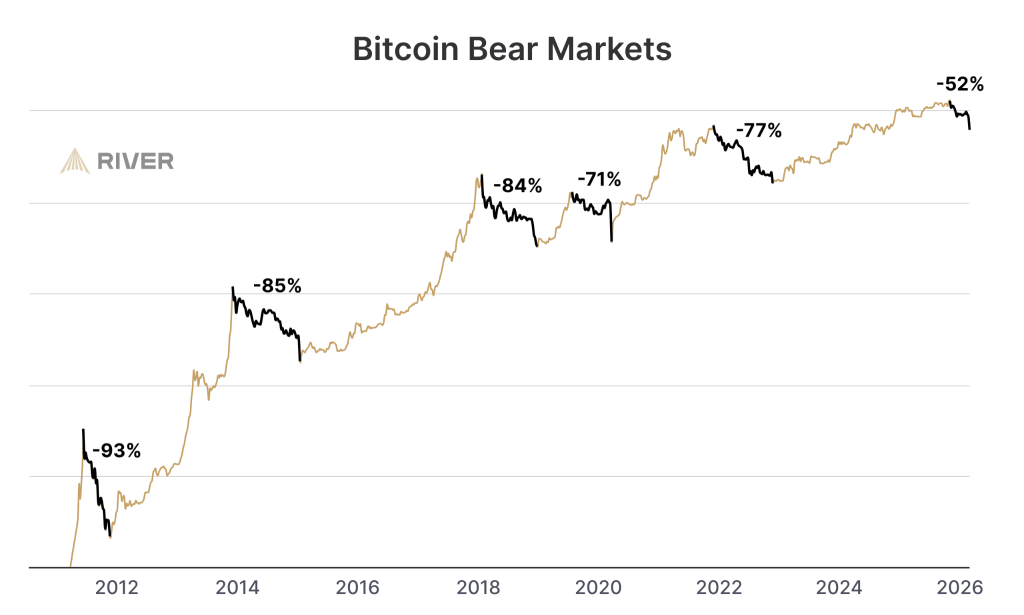
Source: River Financial, As at February 10, 2026. For illustrative purposes only. This chart is a logarithmic (base 10) scale chart where each line on the Y-axis represents an equal % change.
The speed of the recent decline reflected a self-reinforcing cycle, as the unwinding of leveraged positions accelerated selling pressure. More than $1 billion in leveraged trades were liquidated, pushing prices toward levels historically associated with bear-market drawdowns.8
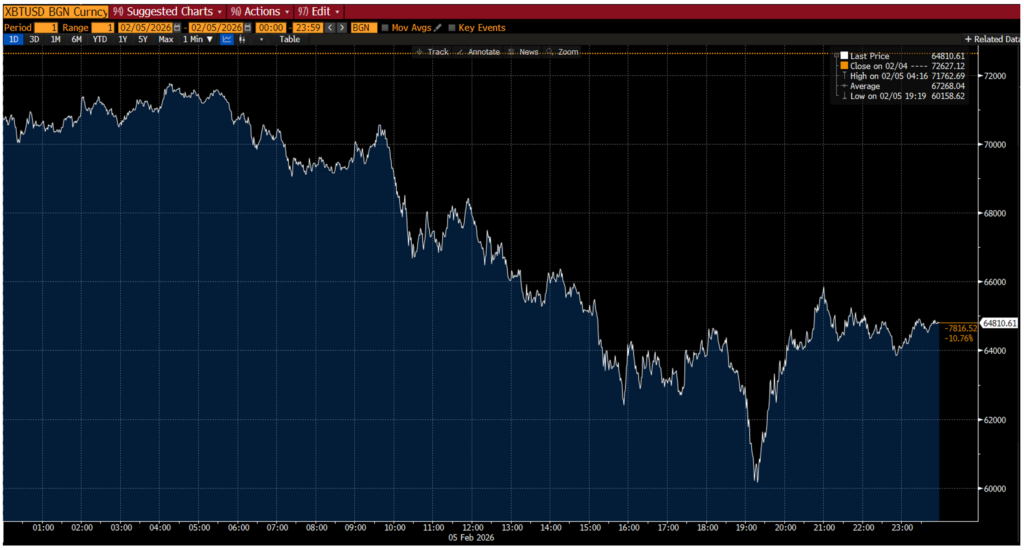
Source: Bloomberg, As at Feb 5, 2026. For illustrative purposes only.
Importantly, this type of reset has precedent. Comparable episodes have often cleared excess speculation from the system and established a more durable base for the next phase of price discovery.
At the same time, several forward-looking catalysts remain in view. A potential shift in monetary policy could reintroduce liquidity into the system, while continued institutional integration, supported by clearer regulatory frameworks such as the Clarity Act, may provide a stronger foundation for future demand.
Market cycles evolve alongside market participants. Today’s Bitcoin ecosystem looks materially different from prior years, characterized by deeper capital pools, expanding infrastructure, and growing strategic interest from large institutional investors.
We cannot predict the precise path forward. However, the underlying trajectory continues to point toward broader adoption and increasing relevance within the global financial system.
For every seller, there is a buyer, and the persistence of institutional engagement suggests that many investors continue to view volatility not as a signal to exit, but as part of the price of admission for a scarce, monetizing asset.
[4] https://bitcoinmagazine.com/news/passing-clarity-act-critical-for-bitcoin
[7] https://river.com/content/why-bitcoin-crashed-feb-2026
Credit: LightFieldSolutions Source: Envato
Disclaimer:
Published March 10, 2026.
The information contained herein is a general description and is not intended to be specific investment advice to any particular investor nor intended to be investment or tax advice. You should not act or rely on the information contained herein without seeking the advice of an appropriate professional advisor. The information contained herein is intended for informational purposes as a summary only, does not constitute an offer to sell any securities or a legally binding obligation, it is qualified entirely by, and should be read in conjunction with, the more detailed information appearing in the prospectuses found on the Evolve Funds Group Inc website at https://evolveetfs.com/
Leverage increases risk.
The unpredictable nature of the cryptoassets can lead to loss of funds.
Certain statements contained herein are forward-looking. Forward-looking statements (“FLS”) are statements that are predictive in nature, depend upon or refer to future events or conditions, or that include words such as “may,” “will,” “should,” “could,” “expect,” “anticipate,” “intend,” “plan,” “believe,” or “estimate,” or other similar expressions. Statements that look forward in time or include anything other than historical information are subject to risks and uncertainties, and actual results, actions or events could differ materially from those set forth in the FLS. FLS are not guarantees of future performance and are by their nature based on numerous assumptions. Although the FLS contained herein are based upon what Evolve Funds Group Inc. and the portfolio manager believe to be reasonable assumptions, neither Evolve Funds Group Inc. nor the portfolio manager can assure that actual results will be consistent with these FLS. The reader is cautioned to consider the FLS carefully and not to place undue reliance on FLS. Unless required by applicable law, it is not undertaken, and specifically disclaimed that there is any intention or obligation to update or revise FLS, whether as a result of new information, future events or otherwise.
Certain information contained in this document is obtained from third parties. Evolve Funds Group Inc. believes such information to be accurate and reliable as of the date hereof, however, we cannot guarantee that it is accurate or complete or current at all times. The information provided is subject to change without notice.